In brief
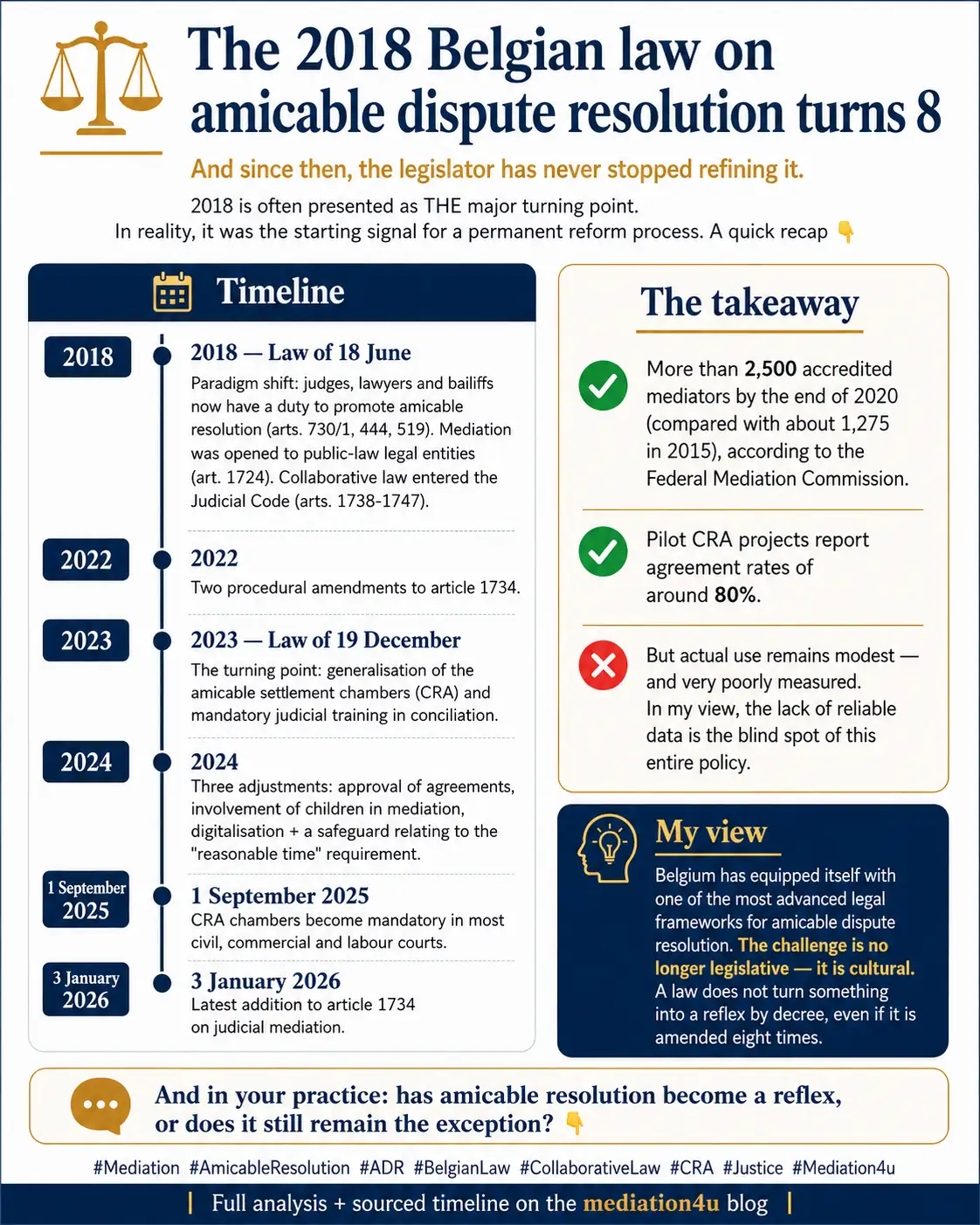
Hailed in 2018 as a landmark, Belgium's law of 18 June 2018 turned out to be merely the starting point of a continuous cycle of reform. Between 2018 and 2026, the Belgian legislator never stopped refining, broadening and consolidating the framework for amicable dispute resolution — to the point of making amicable settlement chambers compulsory, since 1 September 2025, in most civil, commercial and labour courts. Yet, eight years on, the paradox remains: Belgium has equipped itself with a particularly complete legal framework for amicable resolution, but actual uptake stays below its potential — and is still poorly measured. This article retraces what the 2018 law changed, sets out the full timeline of developments up to 2026, and analyses why such a favourable framework still struggles to take root in judicial culture.
1. The starting point: mediation recognised but marginal (before 2018)
Mediation was not born in 2018. Its Belgian legislative history is a long one:
- 19 February 2001: mediation first introduced into the Judicial Code, limited to family matters (Federal Mediation Commission, legal basis).
- 21 February 2005 (Belgian Official Gazette of 22 March 2005, in force on 30 September 2005): the founding law. It created the Federal Mediation Commission (FMC), extended mediation to civil, commercial and labour matters, and inserted Articles 1724 to 1737 of the Judicial Code (FMC).
Despite this foundation, the results were disappointing. Legal scholarship admits it plainly: mediation remained very little used in practice, owing to a lack of awareness among legal practitioners and to insufficient promotion (Cairn.info). Over 2012-2018, Belgium reportedly stood out, according to NotreAccord, for a high number of court proceedings per capita compared with several of its European neighbours (NotreAccord). It was this twofold observation — an effective tool yet shunned, and congested courts — that fuelled the 2018 reform.
2. What the law of 18 June 2018 actually changed
The law of 18 June 2018 on miscellaneous civil-law provisions and provisions to promote alternative forms of dispute resolution — nicknamed the "catch-all" or "waterzooi" law — was published in the Belgian Official Gazette of 2 July 2018 (consolidated text, federal e-Justice portal). Its Title 9 (Articles 204 to 240) entered into force on 12 July 2018; the collaborative-law component, on 1 January 2019 (UCLouvain doctrinal study).
Six contributions structure the reform.
2.1. A paradigm shift: amicable first
The new Article 730/1 of the Judicial Code sets out a guiding principle: the judge shall, at every stage of the procedure, encourage an amicable mode of resolution. Except in summary proceedings, the judge may, as early as the introductory hearing, ask the parties what steps they have taken to settle their dispute amicably and inform them of the options still open (droitbelge.be). Litigation ceases to be the natural starting point.
Worth noting — and revealing of the political compromise — a more radical device, present in the preliminary draft, was dropped during the parliamentary work: requiring litigants to demonstrate an amicable attempt before seising the court. The High Council of Justice had deemed such a constraint excessive in light of the right of access to a court (UCLouvain). Belgium thus opted for strong encouragement rather than obligation.
2.2. New duties for lawyers and bailiffs
- Lawyers (Article 444) must inform clients of the possibilities of mediation, conciliation and any amicable mode, and, where an amicable outcome is conceivable, foster it as far as possible (KMS Partners).
- Judicial bailiffs (Article 519, § 4) are subject to a comparable duty (KMS Partners).
2.3. A considerably broadened scope
Article 1724 opens mediation to any dispute of a financial (patrimonial) nature, whether cross-border or not, including disputes involving a public-law legal entity — civil service, public procurement, town planning, environment, expropriation, administrative penalties. This is a major break: under the 2005 law, a public-law legal entity could resort to mediation only in cases provided for by statute or royal decree (droitbelge.be).
2.4. The judge's power to steer towards mediation
Article 1734 allows the judge to order mediation with the parties' agreement, or — where the judge considers a rapprochement possible — even if only one party consents, at the introductory hearing or at the latest after the defendant's first submissions. A key limit: if all parties object, the judge cannot impose it (KMS Partners). And even when ordered, mediation remains voluntary: each party may end it at any time, without prejudice (droitbelge.be).
2.5. The recognition of collaborative law
An all-too-often forgotten innovation: the law creates an eighth part of the Judicial Code (Articles 1738 to 1747) devoted to collaborative law, applicable since 1 January 2019. Each party is assisted by its own accredited collaborative lawyer. A defining mechanism: if it fails, both lawyers must withdraw and cannot plead in the ensuing litigation — aligning everyone's interests on the success of the negotiation (FPS Economy; Wikipedia).
2.6. Protection of the title of mediator
A new Article 227quater of the Criminal Code penalises with a fine the unlawful use of the title of accredited mediator (text reproduced by GEMME Europe).
3. The full timeline of changes, from 2018 to 2026
Here lies the heart of the matter: the 2018 law did not freeze the law, it opened a permanent worksite. Below is the sequence of legislative interventions affecting the amicable framework of the Judicial Code, as it appears from the official consolidated text (JUSTEL / federal e-Justice) and from the Federal Mediation Commission (FMC, legal basis).
2018 — The major reform (law of 18 June 2018). See section 2. Amicable component in force on 12 July 2018, collaborative law on 1 January 2019.
2022 — Two procedural touch-ups. Article 1734 was amended by the law of 6 November 2022 (in force 1 December 2022), then by the law of 6 December 2022 (in force 31 December 2022), as part of broader civil-procedure reforms (JUSTEL, coordination markers of Art. 1734).
2023 — The generalisation of amicable settlement chambers (law of 19 December 2023, Official Gazette of 27 December 2023). The major turning point of the period. The law enshrines and generalises the amicable settlement chambers (ASCs), inserts Articles 734/1 et seq., and imposes mandatory training for judges and councillors in conciliation and mediation (FMC; Lexgo). As a procedural law it applies immediately, but the actual obligation to have an ASC is set for 1 September 2025 (see section 4).
2024 — A wave of adjustments. Three interventions that year:
- a law of 28 March 2024 (in force 8 April 2024) revises the rules on approval of the mediation agreement and the appointment of the mediator by the judge where the parties disagree (JUSTEL, Arts. 1733 and 1736; FMC);
- a law of 29 March 2024 requires that children be involved in mediation, the mediator now having to state precisely how this was done (FMC);
- a law of 15 May 2024 (in force 7 June 2024) furthers the digitisation of justice and adapts the structure of the FMC; it adds to Article 1734 a notable safeguard: the judge may order mediation of its own motion only "in so far as the reasonable time to obtain a judicial decision is not compromised" (JUSTEL, Art. 1734).
2025 — Entry into force of the ASC obligation (1 September 2025). The culmination of the 2023 law (see section 4).
2026 — The latest adjustment to date. A law of 11 December 2025 supplemented Article 1734 on judicial mediation; it entered into force on 3 January 2026 (JUSTEL, Art. 1734; FMC).
The trend is clear: since 2018, the Belgian legislator has adjusted the amicable framework almost every year. This regulatory intensity is itself a sign — of a reform still searching for its point of balance.
4. The pivot of the period: the amicable settlement chambers (ASCs)
The most structuring development is not so much mediation by a third party as conciliation by the judge. The 2018 law had enshrined the judge's conciliatory mission (Article 731). In its wake, several courts — Brussels first (enterprise court, court of appeal), but also the Hainaut labour court (a pilot in Charleroi from 1 September 2023) — set up, on their own initiative, amicable settlement chambers (FEB / VBO; Courts & Tribunals).
According to the FEB, these pilots achieved high settlement rates, in the region of 80% (FEB / VBO). On the strength of this success, and with the support of the GEMME Belgium association, the law of 19 December 2023 generalised the mechanism (GEMME Europe).
Since 1 September 2025 it has been a legal obligation: all courts of first instance, labour courts, enterprise courts, courts of appeal and labour courts of appeal must have at least one ASC. Family courts have had them since 2014; justices of the peace and police courts — already versed in conciliation — are exempt (Courts & Tribunals, "Talking, it works").
The ASC is an appealing mechanism: voluntary, can be seised before or during proceedings, free of charge to initiate (no court registration fee or procedural indemnity for a direct application), strictly confidential, and run by a conciliating judge who — unlike a mediator — may give an opinion and suggest avenues, while never being the judge who later rules on the case if it fails (MEDENAM; Lexgo). One reservation already raised by the High Council of Justice: the limitation to matters "capable of being settled by transaction" appears, for some disputes, too restrictive (s-mediation.be analysis (PDF)).
5. Where do things stand in practice, in 2026?
5.1. A profession that has clearly grown
At the end of the 2005 transitional period there were, according to the Renson firm, around 1,857 mediators accredited on a temporary basis, falling to some 1,275 in 2015 (Renson firm). After 2018 the trend reverses: the number of active accredited mediators exceeded 2,500 by the end of 2020 — a figure from the FMC's 2020 annual report, relayed by NotreAccord (NotreAccord). More recent public data are not consolidated, which echoes the statistical-gap point made below. On the collaborative-law side, several hundred lawyers have been trained in the Wallonia-Brussels Federation (Tournai Bar). Supply, at any rate, has followed.
5.2. Modest actual uptake — and still poorly measured
This must be said with methodological honesty: reliable, centralised data on the actual volume of mediations conducted before Belgian courts remain scarce. The FMC accredits mediators and maintains their list, but conducts no mediation and does not centralise exhaustive statistics on judicial activity (European e-Justice portal, Belgium factsheet). This data shortage is no detail: the absence of measurement is itself a symptom of an amicable-resolution policy that is insufficiently steered.
What can be advanced lies in the paradox of mediation: when used, it succeeds in a large majority of cases — a success rate often estimated at around 70 to 75% (Institute of Registered Auditors) — and yet is rarely mobilised systematically by the parties and their advisers. A 2011 European study (DG Internal Policies of the European Parliament) even estimated that, for Belgium, mediations would have to fail in a very large proportion (in the region of 90%) for them not to generate collective added value — in other words, even imperfect, mediation would remain economically rational (IRE).
6. Why does such a favourable framework remain underused?
Five families of obstacles, which reinforce one another.
1. The litigation culture and lack of awareness. The first reflex is still to engage a professional in order to "win" rather than to "agree". A statutory duty to inform is not enough to transform long-entrenched habits (Cairn.info).
2. The ambivalent role of lawyers. The information duty under Article 444 remains hard to monitor, and a change of posture — from litigator to facilitator — requires training and a rethink of an economic model tied to litigation (KMS Partners).
3. The irreducibly voluntary nature. No one can be forced to agree: the judge can encourage but cannot durably impose. An essential guarantee of consent, this limit deprives the system of the prescriptive lever that, elsewhere, mechanically boosts uptake.
4. Terminological confusion. The word "mediation" covers very different realities — accredited civil mediation, criminal, debt, the federal ombudsman… — to the point that the FPS Justice itself warns against its improper use (FPS Justice).
5. The shortfall in data, promotion and funding. Without statistical steering, it is impossible to identify what works and to target efforts. Belgian justice also suffers from chronic underfunding (Cambier Avocats), and access to amicable resolution via legal aid remains a work in progress, listed among the FMC's working groups (FMC).
7. Conclusion: a solid foundation, a culture still to be built
Eight years on, the law of 18 June 2018 appears less as an isolated event than as the founding act of a reform cycle running through to 2026. Belgium has equipped itself with a coherent and ambitious arsenal — priority to the amicable, reinforced duties for lawyers, bailiffs and judges, openness to public-law legal entities, collaborative law, protection of the mediator's title — and has steadily refined it, to the point of making amicable settlement chambers compulsory since 1 September 2025 and of further amending judicial mediation on 3 January 2026.
But a law does not change a culture by decree, however often repeated. Actual uptake remains below its potential, held back by litigation habits, the ambivalence of incentives, the voluntary nature of the device and a glaring data deficit. The generalisation of ASCs marks an interesting strategic shift: rather than waiting for litigants to move towards the amicable, the amicable is being installed at the very heart of the courthouse. The real test of the coming years will be twofold: finally measuring seriously what is happening, and durably supporting professionals' change of posture. On that condition the promise of 2018 — to make the amicable a reflex, not an exception — can be kept.
Main sources
- Law of 18 June 2018, consolidated text — Federal e-Justice portal
- Judicial Code, mediation articles (1723/1 to 1737) with 2018-2026 coordination markers — JUSTEL / federal e-Justice
- Official legislative timeline (2001 → 11 December 2025) — Federal Mediation Commission, legal basis of mediation
- Reproduction of Title 9 of the 2018 law — GEMME Europe
- Presentation of the new mediation legislation — droitbelge.be
- Doctrinal study (UCLouvain) on the 2018 law — DIAL UCLouvain (PDF)
- Lawyers' duties / judge's powers — KMS Partners
- Amicable settlement chambers (law of 19 December 2023, 80% settlement, obligation as of 1 Sept. 2025) — Lexgo; FEB / VBO; Courts & Tribunals; s-mediation.be (PDF)
- Collaborative law — FPS Economy; Wikipedia
- Paradox / success rate / 2011 European study — Institute of Registered Auditors
- Number of accredited mediators (over 2,500 in 2020) — NotreAccord; historical trend — Renson firm
Disclaimer: this is general information and does not constitute legal advice. References are up to date with publicly available information as of June 2026; for a specific situation, consult an accredited mediator or a lawyer.