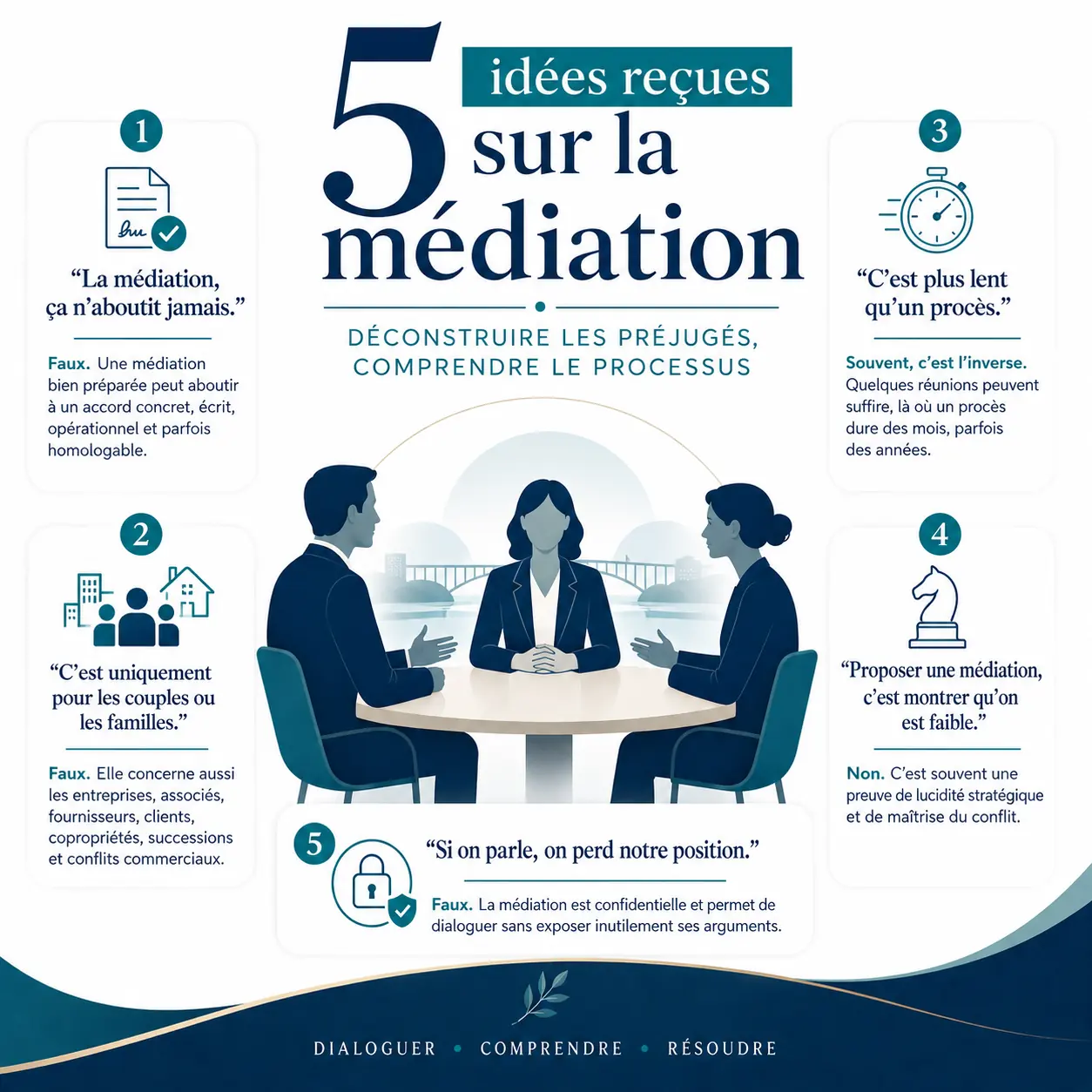
A clearer look at a serious tool that is still too often misunderstood
Mediation is becoming increasingly present in public debate, in businesses, in commercial relationships, in neighbourhood disputes, inheritance matters, co-ownership conflicts and disputes between partners or shareholders.
Yet it remains widely misunderstood.
Many people have heard of mediation, but few really know how it works, when it can be useful, what it can actually achieve and, just as importantly, what it does not replace.
It is sometimes imagined as a simple informal discussion.
As a soft solution.
As an approach reserved for couples going through separation.
Or as an admission of weakness when facing an opposing party.
These misconceptions still too often prevent people from considering mediation, even though it can provide a serious, structured and effective response to many conflicts.
Here are five common misconceptions that deserve to be challenged.
1. “Mediation never leads anywhere”
This is probably one of the most widespread misconceptions.
Some people believe that mediation simply means “putting people around a table” and hoping that they will eventually reach an agreement. Seen in that way, the process may seem fragile, uncertain or naïve.
In reality, well-prepared mediation is based on a clear framework, a method and a rigorous process.
The mediator’s role is not to force an agreement. Nor is the mediator there to impose a solution. The mediator’s role is to create the conditions for useful, safe and constructive dialogue, in which each party can be heard, clarify their needs, understand the other party’s concerns and work towards a realistic outcome.
Mediation can lead to a concrete, written and operational agreement, which in some cases may also be approved by a court.
Of course, mediation does not always guarantee an agreement. It would be dishonest to claim otherwise. But it often offers a real possibility of breaking a deadlock, especially where direct confrontation or legal proceedings risk locking the parties into fixed positions.
Mediation does not promise magic.
It offers a method.
And in many situations, that method can help unlock what seemed impossible.
2. “Mediation is only for couples or families”
Family mediation is probably the best-known form of mediation among the general public. This is why many people spontaneously associate mediation with separation, divorce, parenting issues or family conflicts.
But reducing mediation to this single area is a mistake.
Mediation can be used in many types of disputes, including:
- conflicts between partners or shareholders;
- tensions between companies;
- disputes between suppliers and clients;
- co-ownership conflicts;
- inheritance disputes;
- tensions within an organisation;
- conflicts between an employer and an employee;
- relational difficulties within an association;
- commercial or institutional disagreements.
In the business world, mediation can be particularly relevant when the parties have an interest in preserving a relationship, a reputation, a partnership or continuity of activity.
A court case settles a legal dispute.
Mediation seeks, where possible, to resolve the conflict.
That distinction matters.
In a commercial conflict, for example, the parties are not always simply trying to “win”. They may also want to avoid a brutal breakdown, limit costs, preserve a business relationship, obtain a payment schedule, revise a contract, clarify responsibilities or find a pragmatic solution that a judge could not necessarily build for them.
Mediation is therefore not only a family tool.
It is also an intelligent way of managing professional, economic and relational conflicts.
3. “Mediation is slower than going to court”
This misconception is surprising, but frequent.
Some people think that going to mediation adds an extra step before court proceedings and therefore wastes time.
In many cases, the opposite is true.
Legal proceedings can last several months, sometimes several years. They involve exchanges of written submissions, hearings, adjournments, costs, uncertainty about the final decision and sometimes lasting damage to relationships.
Mediation, on the other hand, can be organised within a much more controlled timeframe.
Depending on the situation, a few meetings may be enough to clarify the points of disagreement, identify the parties’ real interests and build a solution. Mediation can sometimes take place quickly, with a rhythm adapted to the availability and needs of the people concerned.
This time saving is not only about the formal duration of the conflict.
It also concerns:
- the mental time spent on the matter;
- the energy used in confrontation;
- the emotional cost;
- indirect costs;
- the impact on professional activity;
- the loss of trust between the parties.
A conflict that lasts too long often ends up costing far more than what was visible at the beginning.
Mediation can sometimes allow the parties to regain control over the timetable, instead of simply enduring the pace of a legal procedure.
4. “Proposing mediation means showing weakness”
This is a very common fear, especially in commercial, judicial or institutional conflicts.
Many people hesitate to propose mediation because they fear that the other party will see it as a sign of weakness. They worry that it may give the impression that they doubt the strength of their case, want to avoid the judge or are ready to give in.
This is a mistaken view of mediation.
Proposing mediation does not mean giving up your rights.
It does not mean abandoning your position.
It does not mean submitting to the other party.
On the contrary, it can be an act of strategic clarity.
Mediation allows the parties to retain control over the conflict. It makes it possible to explore a solution without necessarily giving up the possibility of legal proceedings if no agreement is reached.
It also allows the parties to check whether a negotiated outcome is possible before investing more time, money and energy in legal confrontation.
In many situations, real strength is not about hardening the conflict at all costs.
Real strength lies in knowing when it is wiser to seek a controlled outcome.
Mediation is not a sign of weakness.
It is often a sign of maturity, responsibility and vision.
5. “If we talk, we lose our position”
This misconception is also very widespread.
In a conflict, each party is afraid of saying too much. The parties fear that their words may be used against them. They worry about revealing their intentions, their limits, their priorities or their room for negotiation.
This caution is understandable.
But mediation is precisely based on a framework of confidentiality.
This framework allows the parties to speak differently than they would in ordinary legal proceedings. It allows them to explain what matters, clarify misunderstandings, identify the real points of blockage and sometimes put forward possible solutions without those ideas immediately being treated as final concessions.
Confidentiality is one of the pillars of mediation.
It protects what is said.
It encourages freer dialogue.
It allows the parties to address their real interests, not only their official positions.
In court, every word can become an argument.
In mediation, words can once again become a tool for understanding.
This does not mean that everything should be said without care. Mediation must be prepared. The parties may be assisted by their advisers. Discussions must remain cautious, useful and respectful.
But speaking within a structured and confidential framework does not mean losing your position.
On the contrary, it can help defend that position better, explain it more clearly and sometimes find a more favourable outcome than prolonged confrontation.
Mediation is not a miracle solution
This must be said clearly: mediation is not suitable for every situation.
It requires at least a minimum willingness to engage in dialogue. It needs a framework. It requires good faith. It does not always replace the intervention of a judge, particularly where urgency, obvious bad faith, a serious imbalance or the need for an imposed decision makes legal proceedings necessary.
But when it is appropriate, mediation can offer a valuable path.
It allows the parties to move away from a purely confrontational logic and return to one essential question:
What concrete solution can still be built?
Mediation does not erase the conflict.
It does not deny disagreements.
It does not ask the parties to forget their rights.
It offers another path: structured dialogue, responsibility and the search for a lasting solution.
Conclusion
There are many misconceptions about mediation. They often come from a lack of information or from confusion between mediation, informal negotiation, conciliation or simple discussion.
Yet mediation is a serious, structured and useful process in many contexts.
It can help avoid lengthy proceedings.
It can preserve important relationships.
It can reduce costs.
It can lead to concrete agreements.
It can also, even without a final agreement, clarify the issues and ease certain tensions.
In a world where conflicts quickly become costly, visible and destructive, learning to handle them differently is not a weakness.
It is a necessity.
At Mediation4U, we believe that a properly supported conflict can become an opportunity for clarification, responsibility and sometimes reconstruction.
Dialogue. Understand. Resolve.