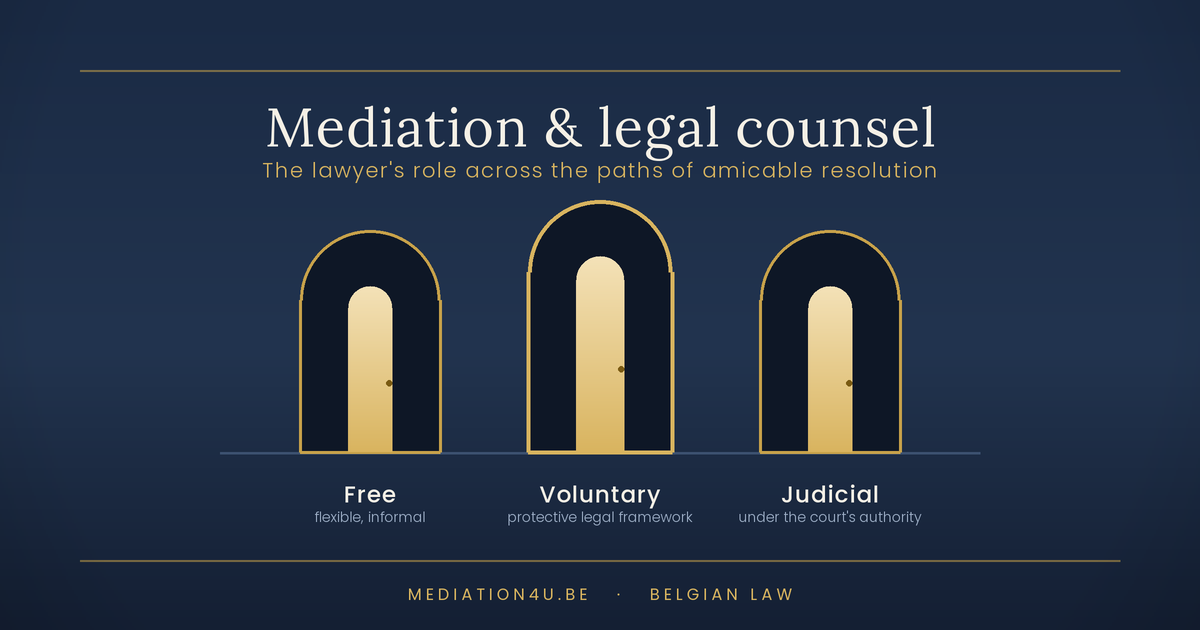
Mediation today holds a growing place in the handling of disputes in Belgium. The Judicial Code devotes a specific framework to it, in articles 1723/1 to 1737, and recent legislative policy clearly aligns with a culture of amicable resolution, in which parties are encouraged to seek a negotiated solution before, during, and sometimes instead of, the trial.
In this context, mediation is no longer a mere optional "sideline": it is a full-fledged mode of dispute resolution, with its own requirements and its own effects. A common confusion must nonetheless be avoided: speaking of "mediation" does not refer to a single reality. Depending on whether one is dealing with free, voluntary or judicial mediation, the level of legal protection, the role of the actors and the timing of the step are not the same.
Free mediation
Free mediation is the most flexible form, but also the least institutionalised. The parties call upon a trusted third party (whether a lawyer, another professional, or someone from their circle) and organise a discussion process between themselves according to terms of their own choosing, without necessarily falling within the legal regime provided by the Judicial Code.
This approach can prove particularly useful when the aim is to preserve a commercial relationship, to test the possibility of an agreement, or to defuse a nascent tension. It allows for fine adjustments, tailored to the reality of the conflict and to the personalities of the parties.
Even so, the practitioner cannot ignore that this freedom comes with a lower degree of legal protection: free mediation does not automatically benefit from the effects attached to legal mediation, notably as regards the suspension of limitation periods, confidentiality as organised by law, or the possibility of having the agreement judicially confirmed. It is therefore not to be ruled out, but to be handled with discernment.
Voluntary mediation
Voluntary mediation constitutes the main gateway into the true legal framework of mediation. Within the meaning of article 1723/1 of the Judicial Code, mediation is defined as a confidential and structured process of voluntary consultation between parties in conflict, conducted with the help of a neutral, independent and impartial third party, who helps them work out a solution themselves.
Voluntary it is by its very nature — the qualifier indicates above all that the initiative belongs to the parties, outside any judicial decision that would impose recourse to the process. This mediation rests on the involvement of a mediator accredited by the Federal Mediation Commission, which guarantees a minimum of training and competence in the conduct of the process.
In return, the law attaches to this form protective effects that free mediation does not offer to the same degree. Among these effects, confidentiality occupies a central place: the Judicial Code governs the regime of communications made during the mediation and strictly limits their subsequent use, so as to guarantee that exchanges can take place without fear of a "backlash" before the court.
The legal regime further makes it possible, under the conditions provided, to secure the parties' procedural position, notably through the suspension of limitation periods and through the organisation of a mechanism for judicial confirmation of the agreement when one is reached.
Voluntary mediation thus appears as a particularly attractive compromise for the lawyer: it leaves the client in control of the solution, while fitting within a normative framework that protects both the process and the outcome that results from it.
Judicial mediation
Judicial mediation, finally, comes into play when the dispute has already been brought before a court. The Judicial Code provides that, in the course of proceedings, the judge may, within the limits set by law, order a mediation at the request of the parties or, in certain cases, on their own initiative, so long as they consider that a rapprochement remains possible. The trial is then temporarily set aside, for the time of an attempt at amicable resolution under the guidance of an accredited mediator.
Here it is worth carefully distinguishing mediation from conciliation: conciliation takes place at the heart of the hearing, in a direct dialogue between the judge and the parties — judicial mediation, by contrast, unfolds in a distinct space, under the responsibility of a third party, using techniques that are no longer those of the judicial decision but those of structured dialogue.
This distinction is not merely theoretical. The recent development of amicable settlement chambers clearly illustrates this blending of the cultures of amicable resolution and of litigation: certain courts now organise specific hearings, oriented towards conciliation and mediation, where the aim is to reconfigure the conflict rather than to decide it outright.
From this perspective, judicial mediation becomes an instrument that is both procedural and strategic. When an agreement is reached and confirmed, it acquires enforceable force comparable to that of a judgment, while retaining the mark of a negotiated solution. It thus makes it possible to reintroduce a dynamic of negotiation into cases that would otherwise run their course to a decision that is sometimes long and costly.
Mediation and legal counsel: two distinct spaces
A clarification is nonetheless called for: in mediation, the mediator does not provide legal advice. Whether a lawyer or from another profession, they intervene neither as judge, nor as arbitrator, nor as counsel to a party — their role consists in facilitating dialogue and guiding reflection towards a solution that respects everyone's needs, without imposing a decision.
Legal counsel lies in another space. It falls to the lawyer, upstream, to analyse the file, to explain to the client the different forms of mediation and their effects, to check the compatibility of recourse to mediation with contractual, insurance or regulatory constraints, and to help choose the most appropriate path. In parallel, it is for the lawyer to secure the commitments made in the protocol and, where appropriate, to review the draft agreement before confirmation. Downstream, finally, they must assess the consequences of that agreement on other disputes or on the overall strategy.
Choosing the right door
Fundamentally, the three forms of mediation pursue a common purpose: to allow the parties to become actors in the solution once again, within a framework more flexible than that of the trial. But they offer neither the same framework, nor the same effects, nor the same degree of legal protection.
The question is therefore not merely whether to "favour the amicable route." It consists, for the lawyer, in identifying — from the moment the dispute arises — the form of mediation that best matches the nature of the dispute, the timing of the proceedings, the level of security sought, and the interests of the client.
It is not a matter of replacing the judge — it is, precisely, exercising legal counsel where it is expected: at the moment of choosing, among the doors of amicable resolution, the one that opens onto the best strategy.
For Mediation4U.be
Xavier van den Bossche
Lawyer — Brussels Bar
Accredited mediator in civil and commercial matters
Certified level 1 — Training in the Palo Alto systemic approach
Normative references (selection)
- Judicial Code, provisions on mediation: articles 1723/1 to 1737.
- Article 1723/1 of the Judicial Code: definition of mediation as a confidential and structured process of voluntary consultation between parties, with the help of a neutral, independent and impartial third party.
- Article 1724 of the Judicial Code: scope of disputes that may be the subject of a mediation.
- Article 1728 of the Judicial Code: confidentiality regime in mediation.
- Article 1734 of the Judicial Code: judicial mediation in the course of proceedings.
- Act of 18 June 2018 on the promotion of alternative forms of dispute resolution, which strengthened the place of mediation in the Judicial Code.
- Act of 19 December 2023 laying down various provisions in civil and judicial matters, which notably generalised the amicable settlement chambers (in French, "chambres de règlement à l'amiable" / CRA) across the courts concerned.